

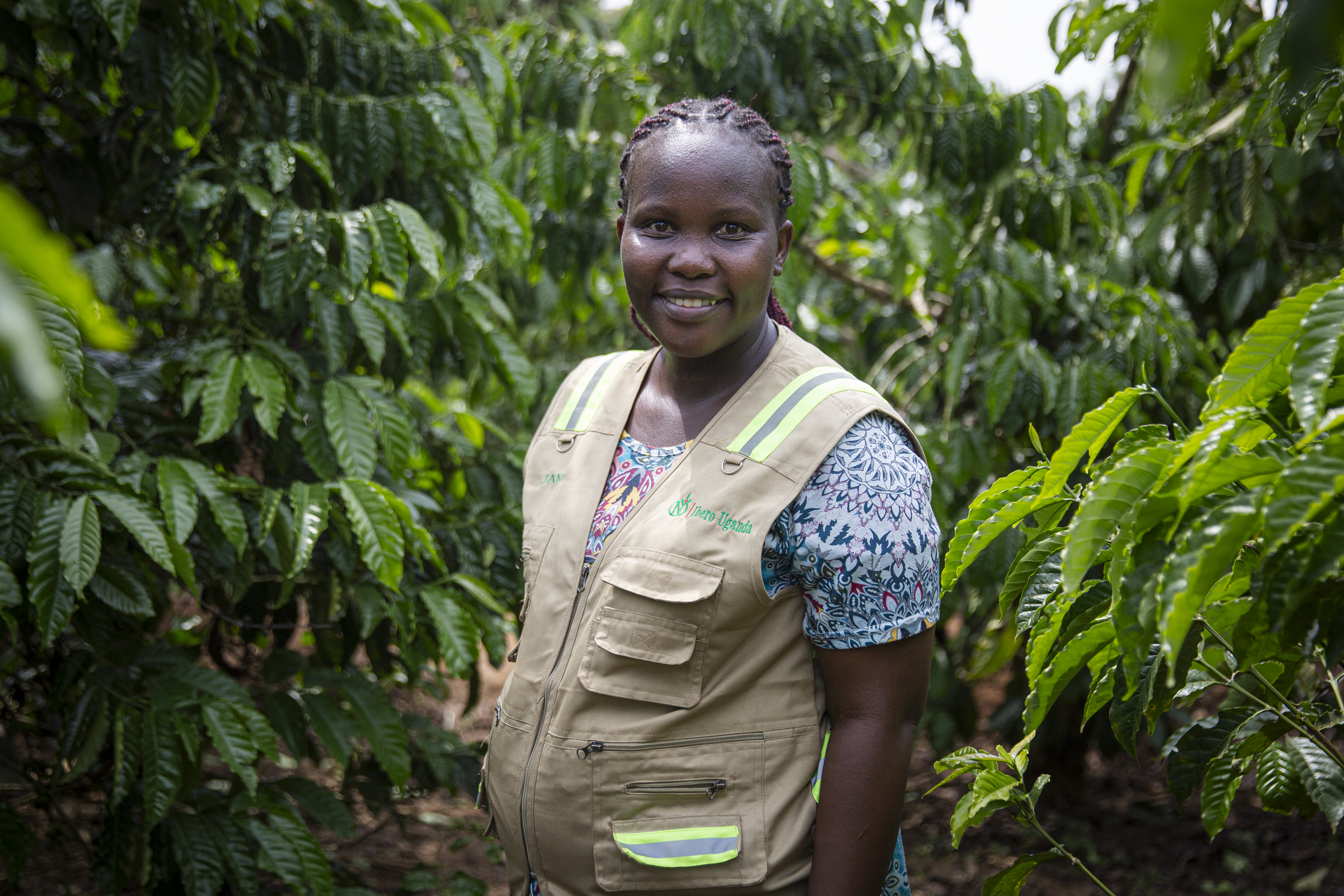
Jane Nakaye is a Farmer Services Unit Officer in Mityana, central Uganda. Officers like Jane are the link between smallholder farmers and NKG Ibero Uganda, part of NKG East Africa.
We spent time with Jane and Ssemugga Matiya, one of the farmers she supports, to understand what that involves.
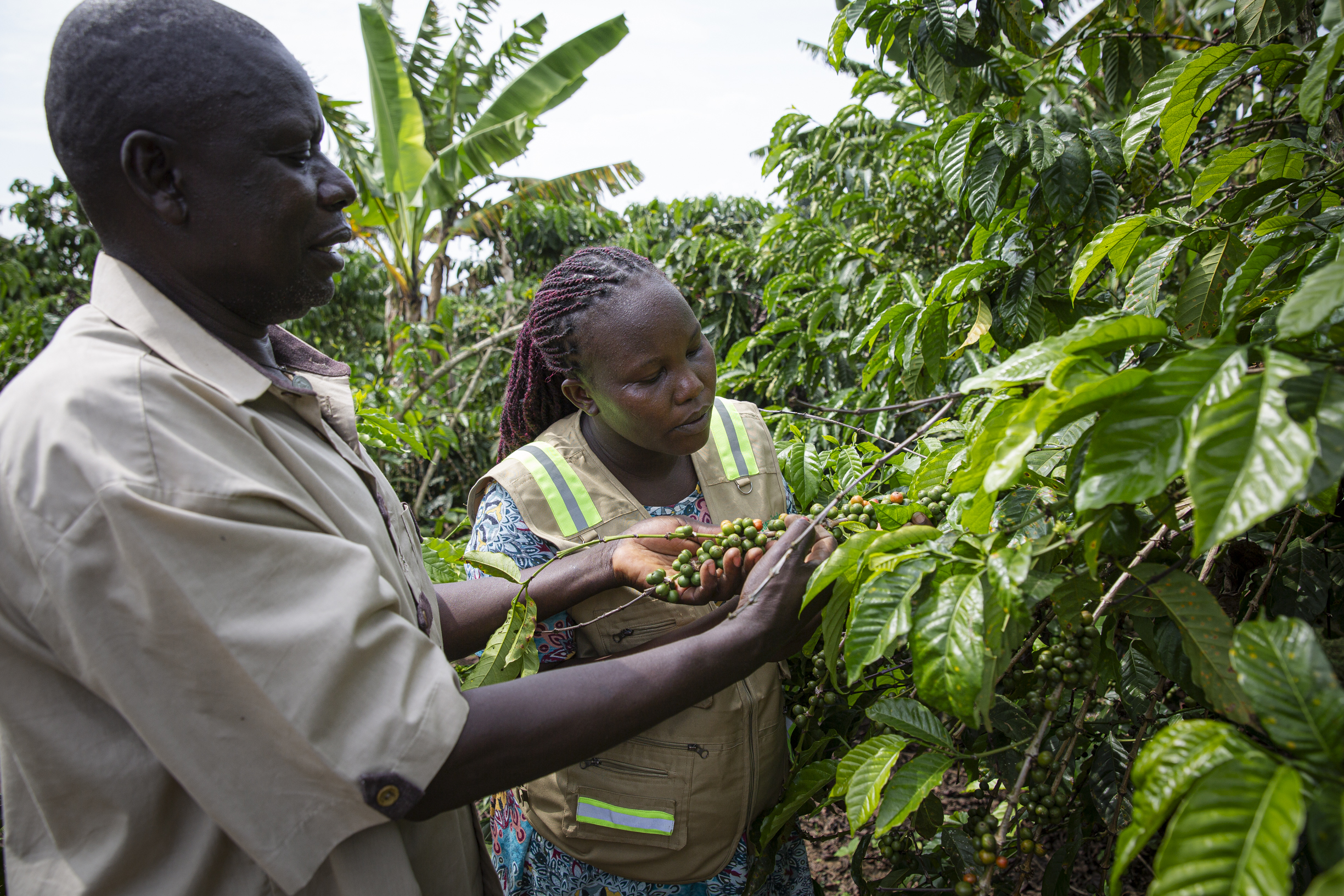
Jane is standing in Ssemugga’s coffee garden, the word Ugandan farmers use for their small farms. She is inspecting the trees and offering advice. She has been here many times before, and she will be back next week to collect his latest batch of kiboko, whole dried coffee cherries.
Ssemugga has grown coffee for more than 20 years and has worked with NKG Ibero Uganda since 2018. Jane visits him two or three times a season, and they speak on the phone more often than he can count. As his Farmer Services Unit Officer, she connects him with everything NKG Ibero Uganda offers. It sounds simple. In practice, a lot depends on it.
The link between farmer and NKG Ibero Uganda
Uganda is one of Africa’s largest coffee producers. Most of its coffee is robusta, grown by smallholder families on small plots. With two harvest seasons a year, most of a farmer’s income arrives in a few short windows. When money runs short in between, many sell their coffee early, at a lower price, to whichever trader comes by.
To prevent this, and to help farmers achieve the best possible quality and productivity, NKG Ibero Uganda takes a different approach. It builds long-term relationships with farmers, understands the pressures they face, and offers support through credit, so they are not forced to sell too early. When the coffee is ready and well ripened, it buys it directly, at the fair market price.
This approach is part of NKG Bloom, a programme that supports farmers with training, finance and a reliable market. In Uganda, the Farmer Services Unit delivers it on the ground, and its role is pivotal. Officers visit farms, advise, train, arrange credit, map each farm for traceability, buy the coffee and share feedback on its quality. NKG Ibero Uganda has more than 70 officers, each working with around 100 to 125 farmers. Jane is one of them, and her work reflects what officers do across the country.
When I look at a coffee garden, I see the farmer’s income, their hard work, and my work too.
Jane Nakaye
The connection works in both directions. As farmers develop their farms, productivity and yields rise, and they earn more from their coffee. Families can invest in their land and homes, and more people choose to grow coffee. In return, NKG Ibero Uganda’s buyers receive quality coffee they can count on, year after year.
Built on trust
They are like parents. They teach us a lot.
Jane Nakaye
None of this works without trust. Farmers are more likely to act on advice from someone they know. And because officers keep returning to the same farms, they can spot problems early.
Jane joined NKG Ibero Uganda in 2021 with a degree in statistics. Five years in the field have given her extensive knowledge of coffee, and farmers rely on her expertise.
The farmers bring a lot of knowledge of their own. Many have grown coffee for decades and have a good understanding of farming from a traditional viewpoint. Jane listens to that experience, and it shapes the advice she gives. From there, she introduces modern practices that help their farms do even better, and many farmers have been quick to adapt.
“They are like parents,” she says. “They teach us a lot.”
Trust is earned on both sides, and growing quality coffee depends on it.
One role, many hats
Ask Jane to describe her job and she will tell you it changes with the season. Like every Farmer Services Unit Officer, she plans her work around the coffee calendar, so different roles take priority at different times of the year.
Much of her week is spent on a motorbike. Her farmers are spread out around Mityana, and the farms are rarely close together. With so many roles, and audits on top, the job could easily become overwhelming. Her answer is careful planning.
“Everything is managed by planning according to the coffee calendar,” she says. “As much as it is hectic, the work is lessened by planning.”
Before the rains
No one is sleeping that season.
Jane Nakaye
Fertiliser has to go on between harvests, when cash is often short. Banks usually ask for collateral and regular repayments, which rarely fit a farmer’s year. NKG Ibero Uganda’s loans are based on the coffee a farmer has sold before, and repaid with coffee at harvest.
Jane makes it work. She visits each farm, checks the trees and past sales, and agrees with the farmer what they can borrow and repay. Then comes the busiest time of her year: getting fertiliser to every farmer and under their trees as the rains begin. Many farmers are stretched with other work, so she keeps calling to remind them.
“No one is sleeping that season,” she says.
For Ssemugga, cash advances on his phone also help with school fees and other costs at home. Without them, he says, farmers would sell their coffee elsewhere just to get money in hand.
Through the season
Two to four times a year, Jane runs training sessions with farmer groups on pruning, mulching, coffee quality and managing money. Between sessions, she visits each farm at least twice a season, reading the trees for signs of pests or disease. If a harvest drops, she goes back to find out why.
It is through these visits that Ssemugga learned how to apply fertiliser and deal with pests such as the coffee tree borer.
When a new farmer joins, Jane registers them and maps their garden, so their coffee can be traced back to where it was grown.
At harvest
Now the focus turns to quality. Jane checks the moisture of each farmer’s coffee before it is collected. For Ssemugga, some of the most useful lessons have come at this stage: how to dry coffee properly, and how to tell when it is ready to sell.
Once the coffee reaches the local buying centre or the mill in Kampala, the loan is deducted and the balance is paid straight to the farmer’s phone, ideally within 24 hours. Ssemugga sees another benefit: there is no large sum of cash to carry home, and nothing for thieves to take. The digital payment is also fully transparent, leaving a clear record for both the farmer and NKG Ibero Uganda.
Closing the loop
The work does not end when the coffee is bought. At the buying centre and the mill, the quality team checks each delivery for how well it was dried, how many defects it has and whether it meets the grade.
Those results travel back down the chain. The quality team shares them with the Farmer Services Unit, and officers like Jane take them back to the farmers. If the coffee was dried well, she tells them. If a batch came in too wet, with too many black beans, or with dirt and stones mixed in, she calls the farmers together to explain what caused it and how to avoid it next time.
The lessons from one harvest shape the next. Farmers learn what good coffee looks like and why it matters, and each season the coffee that arrives has a better chance of meeting the standard buyers expect.
A farmer’s view
Ssemugga has seen the difference on his own farm. Before he joined, he simply harvested whatever his trees gave him. He did not know coffee needed fertiliser, and used coffee husks and cow dung instead.
Today his garden is clean and well kept. His coffee trees, once yellowish, are now green and healthy, and his yields have risen. The extra income goes back into his family: school fees, medical care and food on the table.
When drought came, his coffee held up. Advice from NKG Ibero Uganda on digging trenches to hold water in the soil, along with regular fertiliser, helped his trees through the dry months.
What it adds up to
Over five years, Jane has seen farmers grow from one acre of coffee to five, building new homes along the way. She remembers one woman who started out with a small garden, picking cherries just to buy paraffin and sugar. Today, she has expanded her farm, runs it as a business, and encourages her children to grow coffee too.
Stories like these are what the Farmer Services Unit works towards. Farmers gain a partner they can count on, and NKG Ibero Uganda receives better-quality coffee from people it knows well.
Know the farmer, know the farm
No two officers’ days are the same, and no two farms are either. But the approach stays constant: know the farmer, know the farm, follow the coffee calendar and keep coming back.
For Jane, the work is personal. “When I look at a coffee garden,” she says, “I see the farmer’s income, their hard work, and my work too.”
Written by NKG East Africa Communications
