
From 2021 to 2024, Baragwi Farmers Cooperative Society had a resident agronomist in the field almost every day. Production climbed from 8 million kilograms to 14.7 million. Payments to farmers were strong. Then Bloom paused, and a gap opened where that support had been.
“I think the farmers had nobody to attend to them and then there was climate change,” says Francis Muriithi, Baragwi’s secretary manager, describing the years that followed. The pests and diseases farmers were facing were not new, but a changing climate made them harder to manage. Without the agronomist support that had helped farmers respond, production slipped back to around 10 million kilograms. The extension support, seedling supply and regular farm visits had gone quiet at precisely the moment farmers needed them most.
Now, as of July 2026, NKG Bloom is back in Kenya, now known as NKG Bloom 2.0. But this time, the starting point is different. Rather than asking what project should be delivered, the programme starts by asking a more fundamental question: what does each cooperative need to become stronger, more productive and more robust over the next three to five years?
That distinction matters.
Every cooperative faces many of the same pressures: climate change, pests and disease, rising costs, changing markets and increasingly demanding sustainability requirements. But the problems are rarely identical. A cooperative’s size, membership, infrastructure, extension capacity, experience and ambitions all determine what it needs next.
NKG Bloom 2.0 is therefore built around five areas of support: agronomic training and extension, demonstration farms, certification, quality seedlings, and strategic investment in cooperative infrastructure, but the priorities and pace are determined cooperative by cooperative.
Thirteen cooperative societies from across Kenya came together at NKG East Africa’s Ruiru offices for the programme’s launch in early July of this year. What stood out was not simply a new set of projects. It was a different way of thinking about the relationship: less about delivering interventions, and more about building the capacity of cooperatives to keep improving.
Baragwi and Rungeto Farmers Cooperative Societies show why that approach matters. This is where Bloom 2.0 comes in. Both worked with the original Bloom programme. Both are based in Kirinyaga. Both welcomed its return. But their experiences since the first programme ended, and what they need next, are very different.
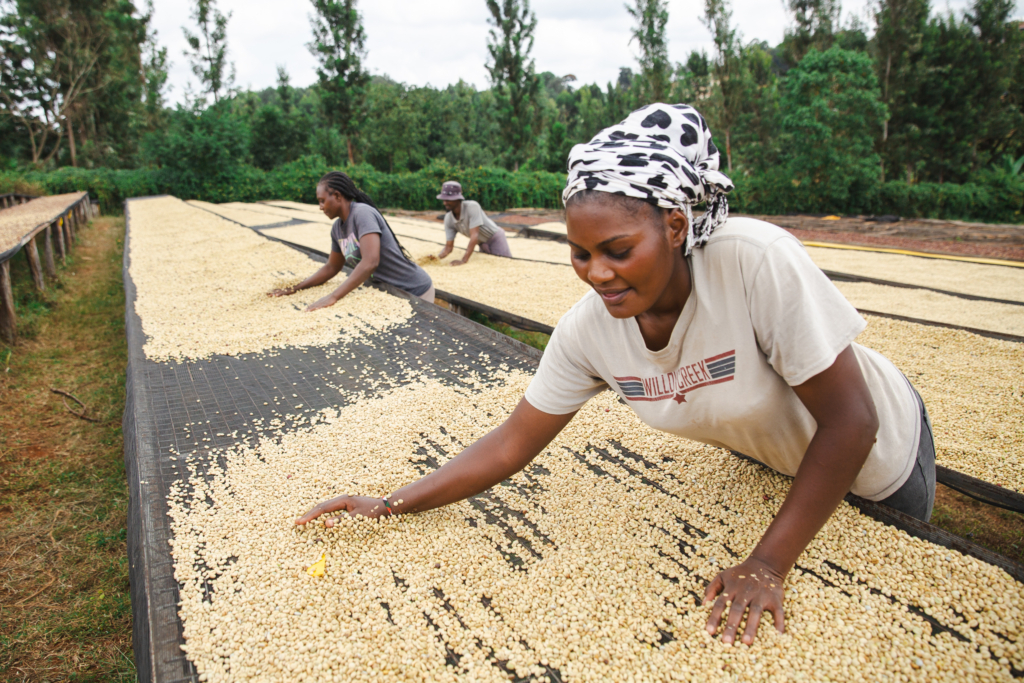
Workers drying coffee at Kianyaga Coffee Factory part of Baragwi Farmers Cooperative Society
“I believe the real challenge is declining profitability.”
Samuel Kahenya, NKG Bloom 2.0 Programme Lead
Why coffee cooperatives need more than a project
For Krista Maruca, one of NKG Bloom 2.0’s programme leads, the need for a new approach reflects several changes happening at once. “The coffee sector itself is changing,” she says. “Expectations from customers, regulations and the market continue to evolve, and we need to evolve alongside them.”
The pressures are felt most directly by the cooperatives. Farmers face rising input and living costs, changing weather patterns and persistent pests and diseases. Cooperatives, meanwhile, have to maintain infrastructure, provide services to growing memberships, meet certification and regulatory requirements, protect quality and remain commercially competitive.
And the challenge is not simply the price farmers receive for their coffee. Samuel Kahenya, NKG Bloom 2.0’s other programme lead, believes the bigger issue is profitability. “Farmers and cooperatives will always ask for better prices,” he says. “I believe the real challenge is declining profitability. Coffee is often not managed as a business, and there are many inefficiencies at both farm and cooperative level.”
That changes the question. The future of coffee cannot depend on one successful harvest, one infrastructure project or one period of high prices. It depends on whether farmers and cooperatives can build businesses capable of remaining productive and competitive over time.
Years of certification work, the Farmer Service Unit and customer-funded projects have given NKG East Africa experience of what works and where the gaps remain. But the role of sustainability support is changing. It is no longer only about helping cooperatives meet requirements. It is increasingly about strengthening the businesses behind those requirements. “Today it isn’t just about meeting a standard or completing an audit. It’s about building coffee businesses that can remain competitive and trusted for many years to come,” Krista says.
That is the thinking behind Bloom 2.0.
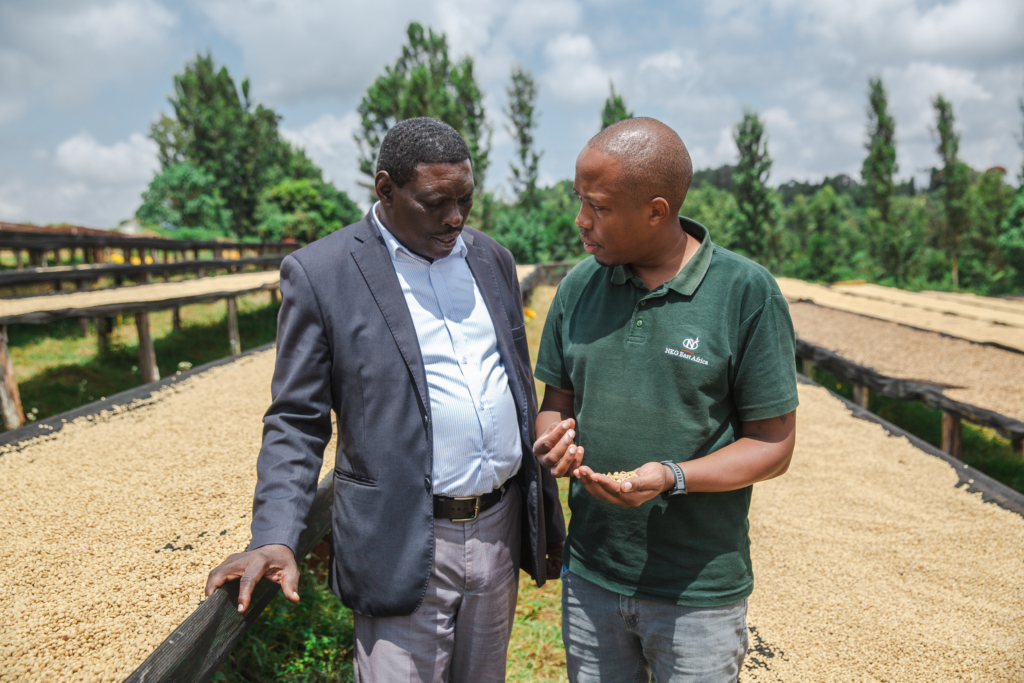
Albert Muchiri Murage, Chairman of Baragwi Farmers Cooperative Society, discussing coffee quality with Samuel Kahenya of NKG East Africa.
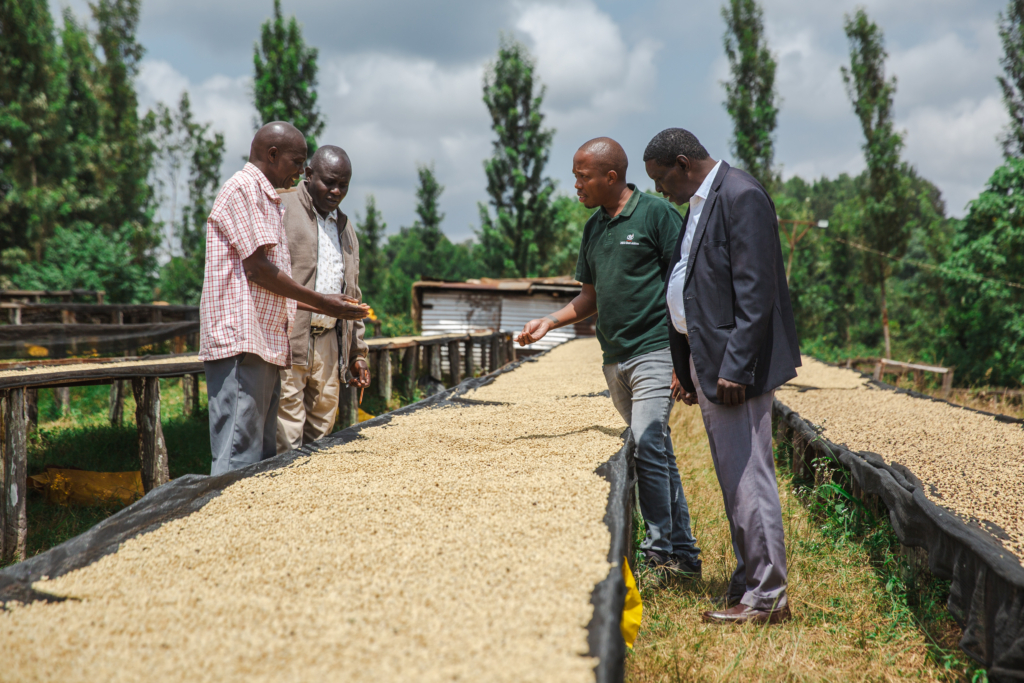
Baragwi leadership team with Samuel Kahenya of NKG East Africa, discussing coffee processing and quality.
NKG Bloom 2.0 focuses on five areas:
NKG Bloom 2.0 focuses on five areas:
- Agronomic training and extension – helping farmers improve productivity and respond to climate, pest and disease pressures.
- Demonstration farms – designed not only to show farmers what is possible but, over time, to become productive assets that generate income for the cooperative.
- Certification support – helping cooperatives maintain access to markets and respond to evolving sustainability expectations.
- Quality seedlings – supporting renovation and expansion with planting material suited to farmers’ needs.
- Strategic investment in cooperative infrastructure – strengthening the systems and assets needed to process coffee efficiently and protect quality.
The list itself is not what makes Bloom 2.0 different. It is the way those tools are used. Rather than deciding in advance which project a cooperative should receive, NKG East Africa starts by understanding where that cooperative wants to be in three to five years, then works backwards to identify where support can have the greatest impact.
At Baragwi, for example, the immediate priorities are clear. “We don’t have enough seedlings to supply to our farmers, because the demand is very high,” says Albert Muchiri Murage, Baragwi’s chairman. With approximately 25,000 members and membership continuing to grow, access to climate-appropriate, quality seedlings is one of the most immediate ways the cooperative can support its own ambitions.
Its five-year goal is straightforward: every member producing more than 10 kilograms of cherry per coffee tree. Infrastructure is another priority. For years, Baragwi has relied heavily on wooden drying tables.”The other challenge is the drying tables,” Albert explains. “We use the drying tables for drying coffee, and mostly we use wooden ones. NKG East Africa is assisting us to build the metal ones, which helps coffee to dry fast and evenly, and therefore contributes to increased quality. The labour is minimal, in comparison with the wooden one.”
At Rungeto, the situation is different. The cooperative was in a good place when the first phase of Bloom ended and continued to grow during the years that followed. Its membership has since nearly doubled, while its extension team has not grown at the same rate. “With only two extension officers, they can’t really cover the catchment area for our farmers,” says Samuel Karanja Muiruri, Rungeto’s secretary manager.
The cooperative is not returning to Bloom 2.0 because it has failed to manage without the programme. Rather, its growth has created new demands for support. Increasing extension capacity is now one of its most immediate needs, particularly as it works to reach a much larger membership.
That is precisely the point. The same five tools can support different cooperatives in very different ways.
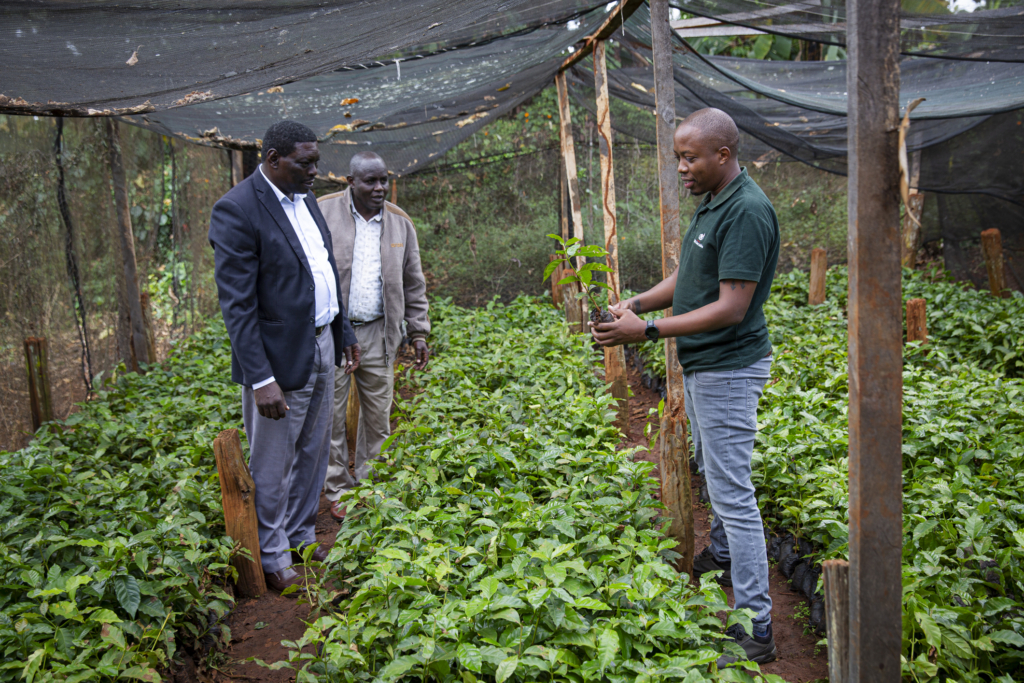
Samuel Kahenya, NKG Bloom Programme Lead, discussing quality coffee seedlings with Albert Muchiri Murage, Chairman, and Francis Muriithi, Secretary Manager, Baragwi Farmers Cooperative Society.
“Our ambition is for demonstration plots to also become productive business assets for the cooperative itself.”
Krista Maruca, NKG Bloom 2.0 Programme Lead
From demonstration plots to business assets
Demonstration farms are one of the clearest places to see NKG Bloom 2.0’s approach at work. Traditionally, these plots have simply shown farmers new agronomic techniques. Under Bloom 2.0, NKG East Africa wants them to become something more. “Our ambition is for demonstration plots to also become productive business assets for the cooperative itself,” Krista Maruca explains. “Over time it should generate enough revenue to cover its own maintenance and contribute to the cooperative’s operations.”
The distinction is important. If a cooperative can eventually generate income from an asset created with programme support, that asset becomes part of the cooperative’s own business model rather than something dependent on continued external funding.
At Baragwi, the model is already beginning to take shape. Income from the demonstration plots is intended to subsidise coffee processing costs, reducing the amount farmers have to contribute. “The result will end up in farmers’ better payments,” Francis Muriithi says.
Rungeto is at an earlier stage. Its existing demonstration plots are smaller and member-owned, rather than structured as cooperative assets. The response is not to copy Baragwi’s model in it entirety. It is instead, to help Rungeto build the capacity and asset base that make a similar model possible.
That is Bloom 2.0 in practice: the programme is designed around the cooperative, rather than fitting the cooperative into the programme.
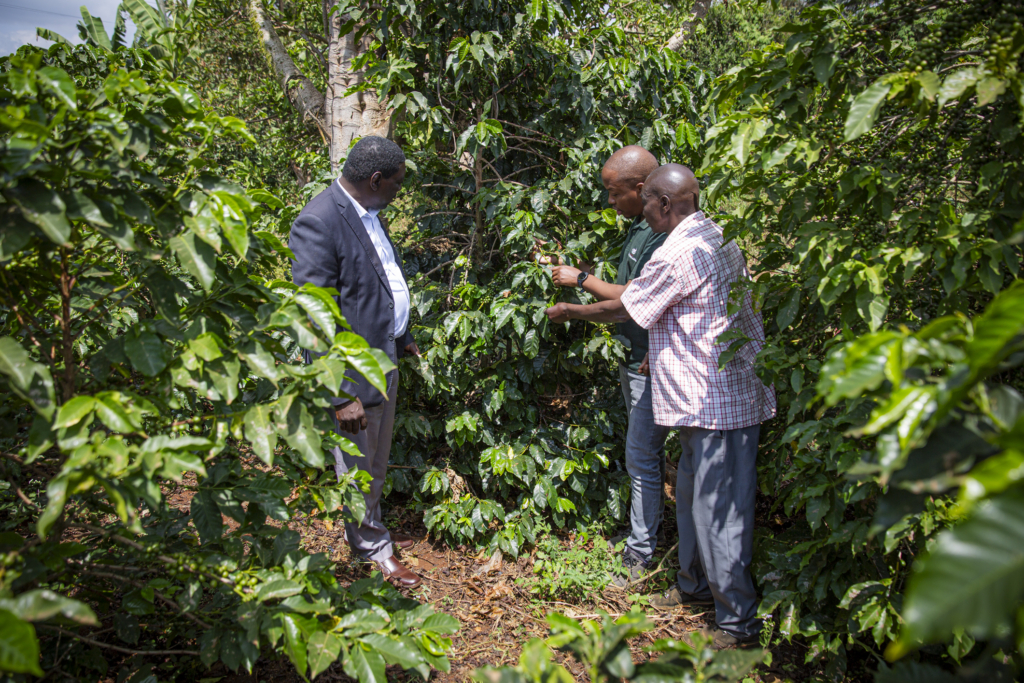
Albert Muchiri Murage, Chairman, and David Waweru, Factory Manager at Kianyaga Coffee Factory, showing Samuel Kahenya, NKG Bloom Programme Lead, the demonstration farm at Kianyaga Coffee Factory.
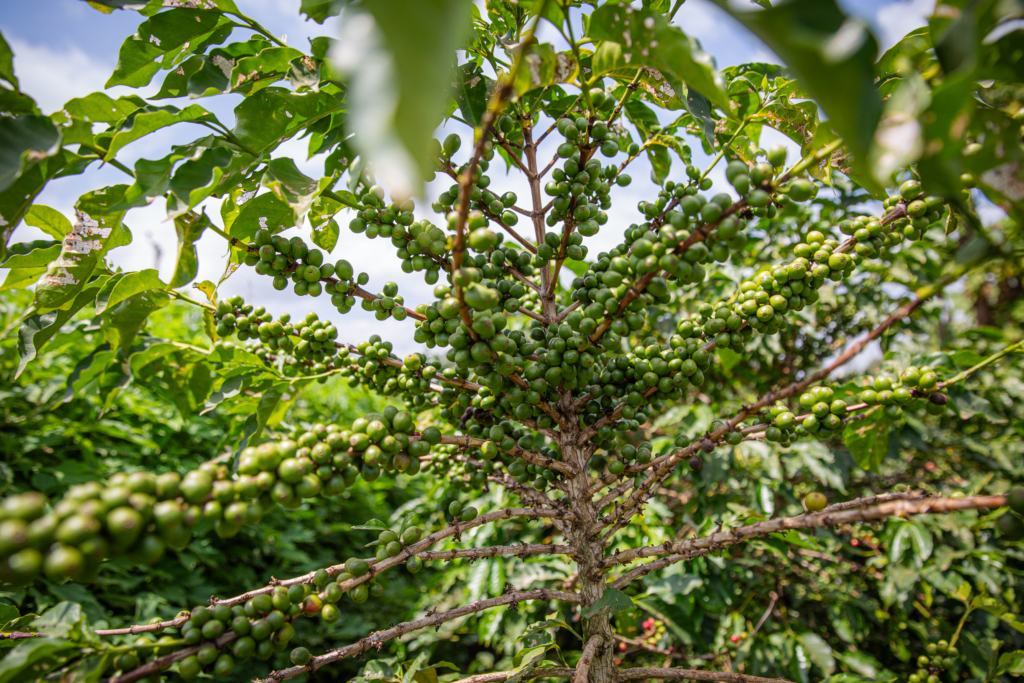
Coffee tree full of cherries on a demonstration farm at Kianyaga Coffee Factory.
What cooperatives can struggle to do alone
The examples from Baragwi and Rungeto point to a broader challenge.
Cooperatives may know what they need to do, but that does not mean they always have the people, systems, infrastructure or financial capacity to do it at the necessary scale.
Rungeto knows that its extension coverage needs to grow. Baragwi knows that farmers need more seedlings. Both understand the importance of infrastructure and quality. Both face growing sustainability and compliance expectations. But turning those priorities into long-term investment is difficult when a cooperative is simultaneously trying to serve thousands of farmers, manage processing operations, maintain infrastructure, respond to changing regulations and deliver returns to members. This is where long-term partnership becomes important.
Rather than treating each problem as an isolated project, Bloom 2.0 aims to help cooperatives strengthen the underlying capacity that allows them to keep solving problems themselves.
“Those are relationships that you build over time.”
Samuel Karanja Muiruri, Secretary Manager, Rungeto Farmers Cooperative Society
A partner who stays
For Samuel Karanja Muiruri, the value of a long-term relationship goes beyond individual projects. Whether the market is up or down, he says, he knows he has a guaranteed partner who will always offer him the best price available. He points to a recent season when the market for dried cherry, known locally as mbuni, dropped sharply. Another cooperative brought the same coffee to sell at the same time. His mbuni was bought first. “Those are relationships that you build over time,” he says.
That relationship matters because coffee investment is inherently long term. A farmer who plants a new seedling may wait three years before it produces sufficient quantities of coffee. Training, soil improvement and farm renovation similarly require patience before the benefits become visible.
For Samuel Kahenya, the relationship works in both directions. “We don’t have all the answers at NKG East Africa. The market does not have all the answers. And we don’t expect our producers to have all the answers. This is a journey that we are all travelling together,” he says. “I like putting ourselves in the same boat as the producers. It’s not that we are the buyers and they are the producers, no, we are in the same boat. It’s just that our responsibilities are different.”
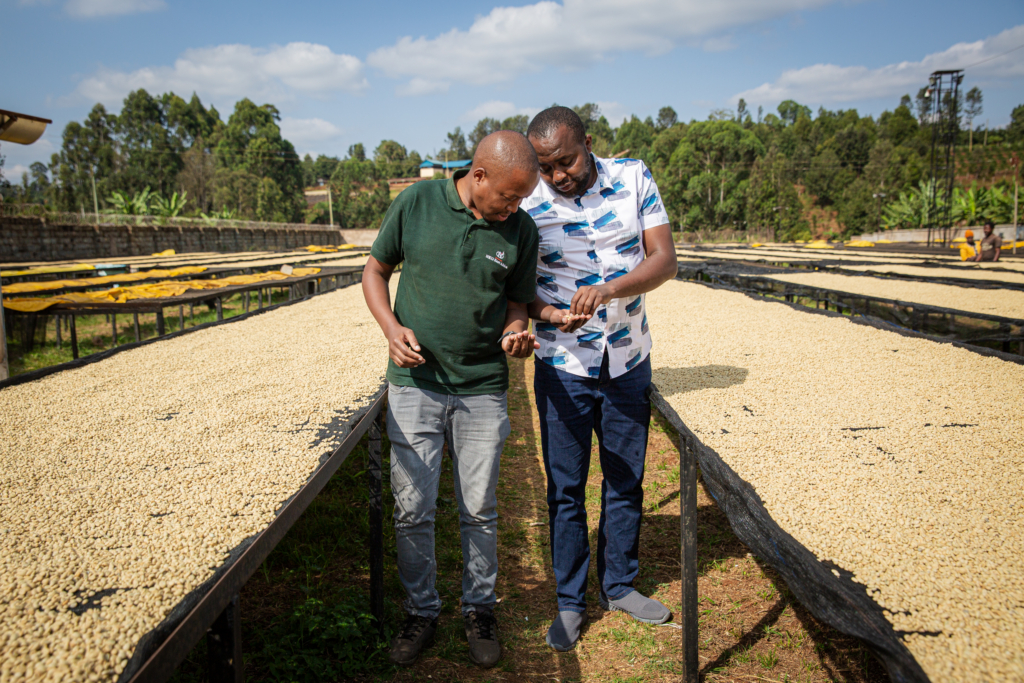
Samuel Kahenya, NKG Bloom Programme Lead and Samuel Karanja Muiruri, Secretary Manager, Rung’eto Farmers Cooperative Society, checking the quality of green coffee on metal drying beds at KII Factory.
“Quality that comes from the farm cannot rise at the washing station. It can only reduce.”
Samuel Kahenya, NKG Bloom 2.0 Programme Lead
Why this matters to coffee customers
The case for Bloom 2.0 is therefore not limited to farmers or cooperatives. It is also increasingly relevant to the customers buying Kenyan coffee.
For Daniel Magu, NKG East Africa’s Speciality Coffee Trader, customer expectations have changed significantly. Buyers increasingly want to understand not only where their coffee comes from, but how it was produced, how risks are managed and whether the supply chain can demonstrate credible sustainability performance. That includes requirements around traceability, the EU Deforestation Regulation (EUDR), human rights due diligence, responsible sourcing, food safety and environmental compliance. Customers are increasingly “seeking trusted partners who can demonstrate robust risk management and credible sustainability performance,” Daniel says.
The connection between those requirements and what happens at cooperative level is direct. A cooperative that can maintain accurate farm records, meet certification requirements, invest in infrastructure and support farmers is better positioned to provide the transparency and reliability customers increasingly expect.
And quality follows the same chain. “Quality that comes from the farm cannot rise at the washing station,” Samuel Kahenya says. “It can only reduce.”
For Daniel, that makes the link between Bloom 2.0 and the customer proposition straightforward. “Agronomy services, improved cherry-picking practices, enhanced drying infrastructure, and stronger cooperative management all contribute to improved quality and consistency, and a more reliable cup profile season after season.”
The metal drying tables at Baragwi may look like a local infrastructure project. The extension officers at Rungeto may look like a local capacity issue. For a coffee customer, they are part of the same supply chain.
The objective is to protect the quality, traceability and stability that customers ultimately depend on.
From quality to market access
For Rungeto, the relationship between sustainability assurance and market access is already clear. “Without sustainability assurance for the final consumer, it’s a challenge to sell your coffee,” Samuel Karanja Muiruri says. Certification and EUDR compliance are therefore not simply paperwork exercises. They are part of maintaining access to international markets.
At the same time, Kenya cannot compete on volume with the world’s largest coffee-producing origins. With Brazil’s coffee volumes rising, Samuel Karanja Muiruri sees quality as the country’s strongest differentiator. “What will distinguish Kenyan coffee from the rest of the world is only quality,” he says.
That puts even greater importance on everything that happens before the coffee reaches the exporter. Good agronomy protects productivity. Better extension helps farmers respond to problems. Quality seedlings support future production. Effective processing infrastructure protects the quality created on the farm. Certification and traceability help keep the resulting coffee connected to markets.
Bloom 2.0 brings those pieces together.
The sign at the entrance to Rungeto Farmers Cooperative Society.
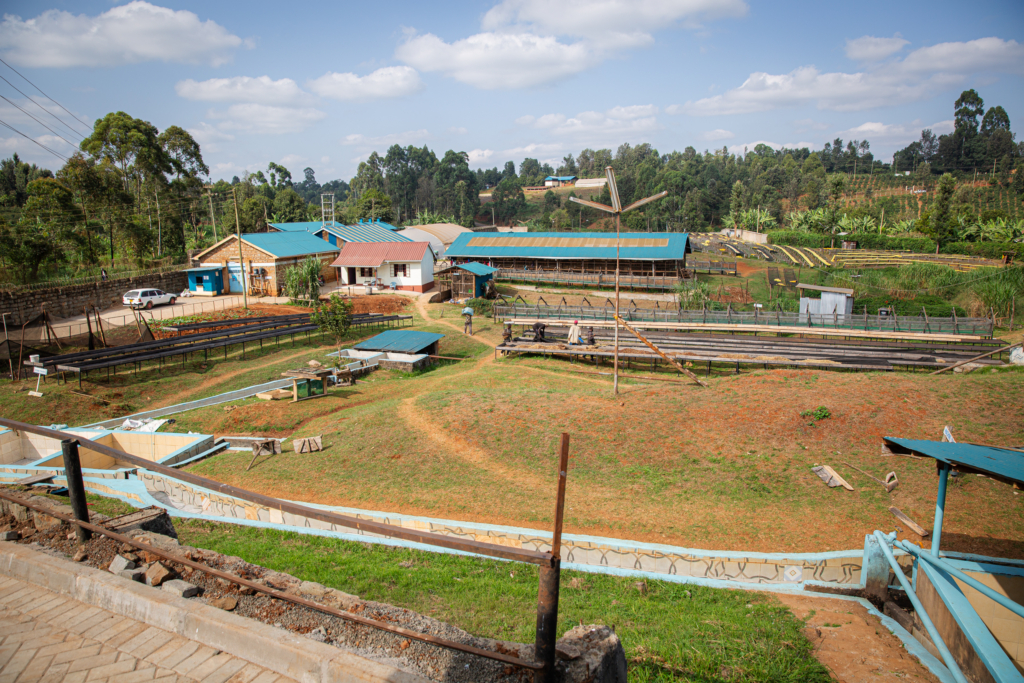
A view of KII Factory, Rung’eto Farmers Cooperative Society.
“Quality that comes from the farm cannot rise at the washing station. It can only reduce.”
Samuel Kahenya, NKG Bloom 2.0 Programme Lead
What success looks like
The ambition is visible in the targets already being set by the cooperatives.
At Baragwi, production has climbed back to 13 million kilograms, with a target of 15 million by 2026/2027. The cooperative wants every member producing more than 10 kilograms of cherry per tree.
At Rungeto, coffee sales have grown from around 500 million Kenyan shillings five seasons ago to 928 million this season, bringing the cooperative within reach of its first billion. Samuel Karanja Muiruri points to what that growth has meant for farmers: more cars, more stone-walled homes and more children going to college. The cooperative’s own five-year ambition is to increase yields from 4.5 kilograms per tree, already around double the national average, to 6 or 7 kilograms.
But the numbers are only part of the story. There is a deeper question facing both cooperatives: will coffee remain attractive enough for the next generation to stay in it?
Samuel Karanja Muiruri says land that has supported coffee farming for generations is increasingly being sold for real estate because people believe property will be more profitable than coffee.
At Baragwi, however, Francis Muriithi sees signs of the equation beginning to change. A new generation of farmers is taking an interest in coffee because, after years of weak returns, the economics are once again beginning to make sense.
That may ultimately be the most important measure of Bloom 2.0’s success. Not simply whether a cooperative produces more coffee or a customer can trace a shipment, or if a project delivers its intended output. But whether coffee becomes a business that farmers can continue to invest in, cooperatives can continue to build around, and the next generation can see a future in. “Securing the future of coffee is a shared responsibility,” Samuel Kahenya says. “No single organisation can do it alone.”
For NKG East Africa, that means moving beyond the idea of a programme that starts, delivers and moves on.
Bloom 2.0 is intended to be something more durable: a long-term partnership that grows with the cooperatives themselves, helping them build the productivity, capacity, quality and resilience needed to keep coffee farming viable for the future.
Because ultimately, securing the future of coffee means making coffee worth staying in, and worth passing on.
Photos by: Alice Oldenburg
